
Infraestruturas de Portugal describes the crossing as part of the Lisbon–Madrid high-speed line, together with rail access to the airport and a station for conventional and high-speed services. The Government has mandated IP to deliver Lisbon–Madrid in 2034, with a journey of about three hours.
The July 2026 announcement calls it a new road-rail bridge between Chelas and Lavradio. Its alignment, cost and environmental assessment are separate from the airport’s and are not covered by the airport’s €7.9–8.9 billion estimate as far as the sources show.
On our map only the two named endpoints appear. No route is drawn.
Proposed access links (schematic)
Schematic, not to scale. No alignment has been approved or published; nothing here shows a route.
- Central Lisbon / Chelas
- Third Tagus Crossing — proposed road-rail bridge
- Barreiro / Lavradio
- Dedicated rail link (proposed) · about 20 minutes · target 2034
- Airport station (4 tracks, 3 platforms, proposed)
Proposed road schemes · 250 km new · more than 50 km upgraded
- EN4 · EN10 · EN119 → airport links
- A33 → A12 / A13
- IC13: airport – Ponte de Sor – Alter do Chão
- EN118 dualling · EN119 upgrade
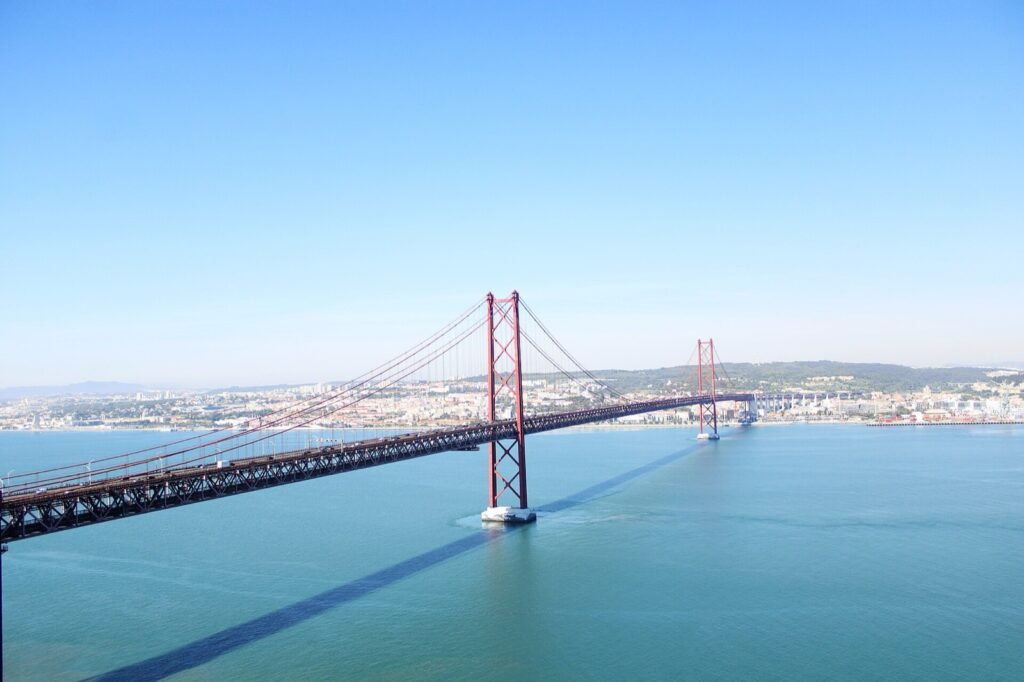
Illustration — not to scale, not the airport design
A suspension bridge across the river. The Third Tagus Crossing is a separate, proposed project.
Illustration: Luís de Camões Airport Observatory (original work).
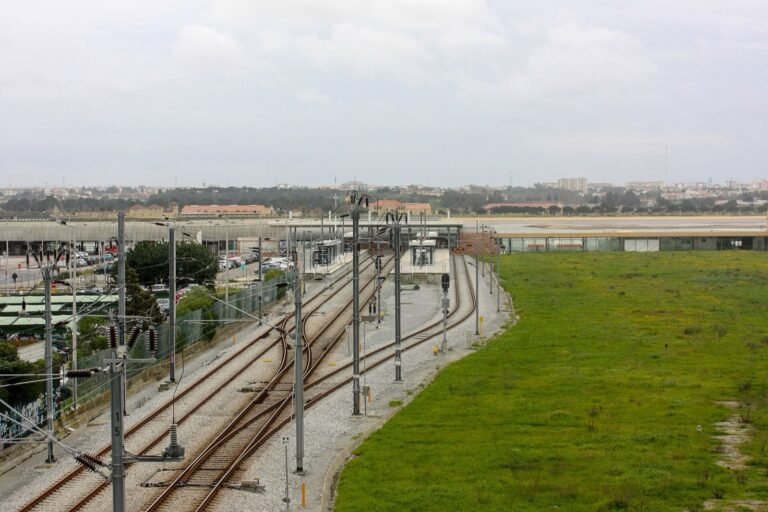
Barreiro station on the south bank, at the southern end of the proposed Chelas–Barreiro crossing. January 2020.
“Estação Ferroviária do Barreiro, panorama. 01-20 (02)”, © Rúdisicyon, CC BY-SA 4.0, via Wikimedia Commons. Resized to 1,600 px wide.
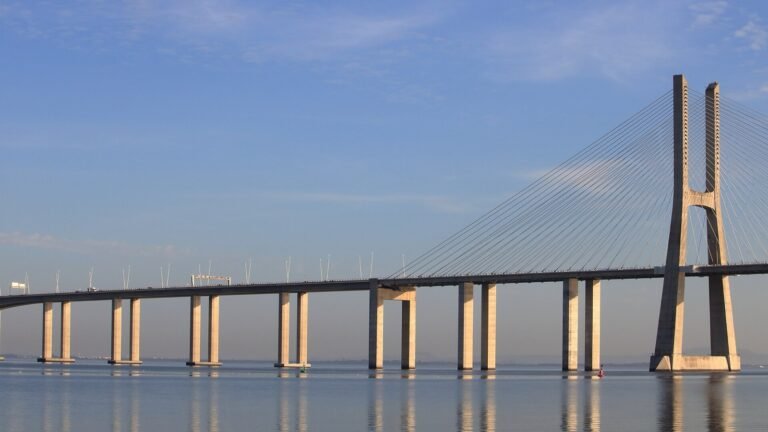
The Vasco da Gama Bridge carries the A12 motorway from Lisbon to the south bank, towards Montijo and Alcochete. The proposed road schemes include connecting the A33 to the A12. October 2019.
“Ponte Vasco da Gama from Parque Tejo”, © André B. Matos, CC BY-SA 4.0, via Wikimedia Commons. Resized to 1,600 px wide.


What the documents say
- Status: Target / forecast Target
The Government mandated IP to bring forward the studies needed to deliver the Lisbon–Madrid high-speed link in 2034, with a journey time of about three hours.
Source: Infraestruturas de Portugal Details and history: Lisbon–Madrid by high-speed rail in 2034
- Status: Officially proposed Proposal
Infraestruturas de Portugal describes the Third Tagus Crossing on the Chelas–Barreiro axis as part of the Lisbon–Madrid high-speed line, together with rail access to Luís de Camões Airport and a station for conventional and high-speed services.
Source: Infraestruturas de Portugal Details and history: Third Tagus Crossing is part of the Lisbon–Madrid high-speed line
- Status: Officially proposed Proposal
The airport is to be 20 minutes from central Lisbon by train, through a dedicated link via the Third Tagus Crossing, a new road-rail bridge between Chelas and Lavradio.
Source: Portuguese Government (XXV Constitutional Government) Source: ANA – Aeroportos de Portugal (VINCI Airports) Details and history: About 20 minutes by train to central Lisbon
Open questions
No open questions recorded for this topic.
Questions answered
What is the Third Tagus Crossing?
A proposed new road-rail bridge across the Tagus between Chelas (Lisbon) and the Barreiro/Lavradio area. Infraestruturas de Portugal treats it as part of the Lisbon–Madrid high-speed line, which also serves the airport.
Source: Portuguese Government (XXV Constitutional Government) Source: Infraestruturas de Portugal Permalink: What is the Third Tagus Crossing?
Has the route of the bridge been fixed?
Not in any approved geometry the observatory has found. The sources name the endpoints (Chelas and Barreiro/Lavradio); the map shows those endpoints only and draws no alignment.
Source: Portuguese Government (XXV Constitutional Government) Source: Infraestruturas de Portugal Permalink: Has the route of the bridge been fixed?
Sources
No documents match these filters.
Related explainers
Explainer
The 20-minute train: the rail link and the Third Tagus Crossing
The airport’s headline access promise rests on a bridge and a line that are not yet built or approved. What has been announced, and by whom.