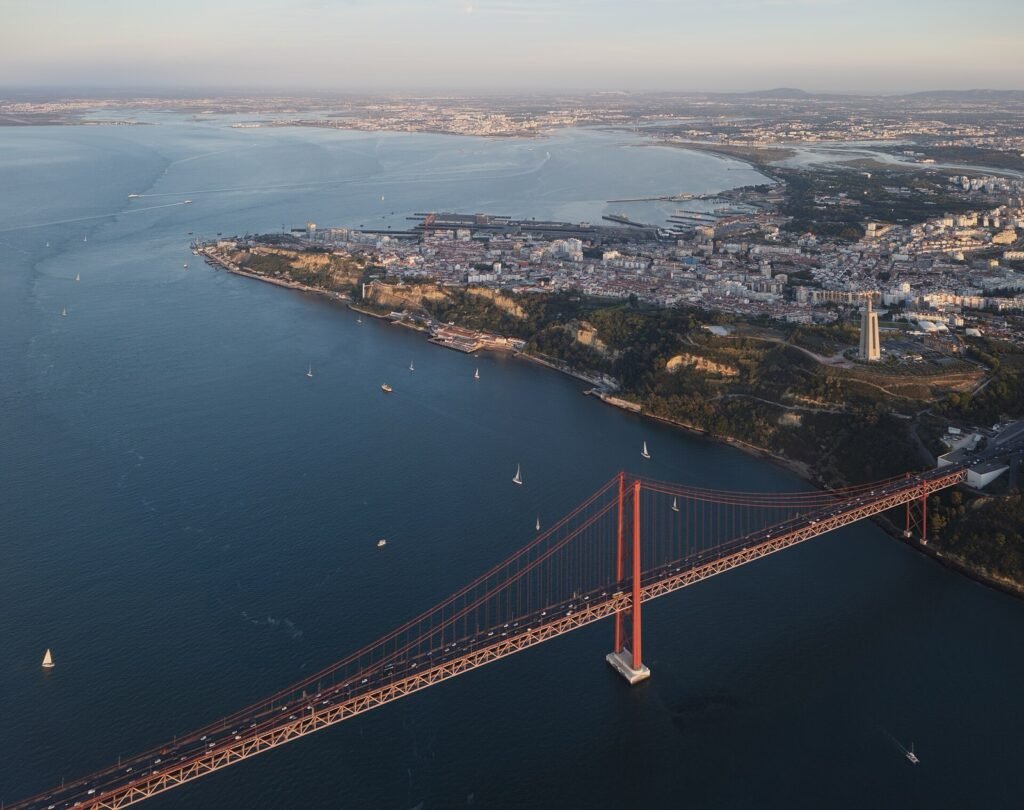

The 2024 base model foresaw two runways handling 90–95 movements an hour, with possible expansion to four. In 2025 the concession’s minimum specifications were reopened, including openness to a shorter maximum runway length and wider spacing for triple independent operations.
On 28 September 2026 the Government asked ANA to demonstrate the configuration of runways and taxiways and their full compatibility with Code F aircraft, as well as capacity and operational flexibility. Airspace is to be restructured to fit the airport alongside civil and military traffic.
Flight paths and noise contours depend on these choices. The observatory will not draw runways until an official geometry exists.
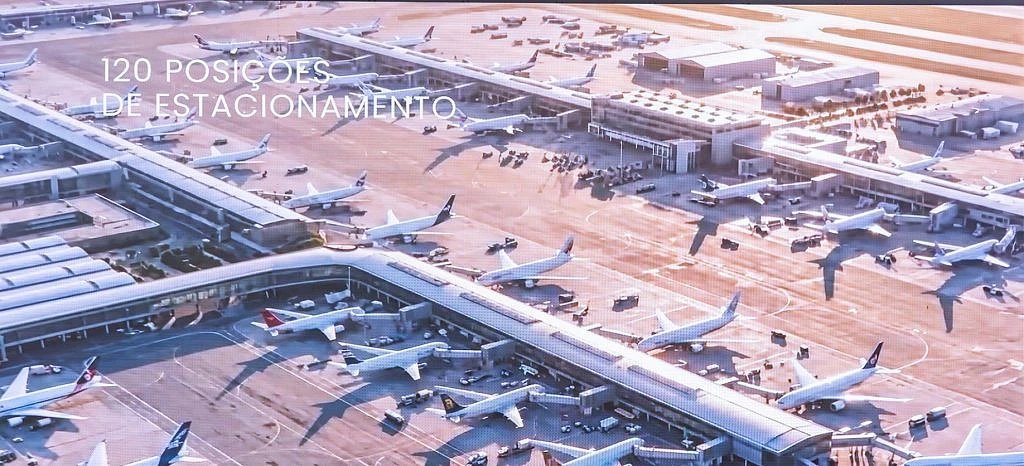
Concept CGI — not an approved design Luís de Camões concept (2026)
Piers with contact boarding bridges and remote stands. ANA's proposal has 120 aircraft stands (the text is ANA's). Airline colours in the image are illustrative and imply no airline commitment.
“Aeroporto Luís de Camões — posições de estacionamento”, © ANA – Aeroportos de Portugal, used with permission, via copy published by Pontos pra Voar. Converted to JPEG.
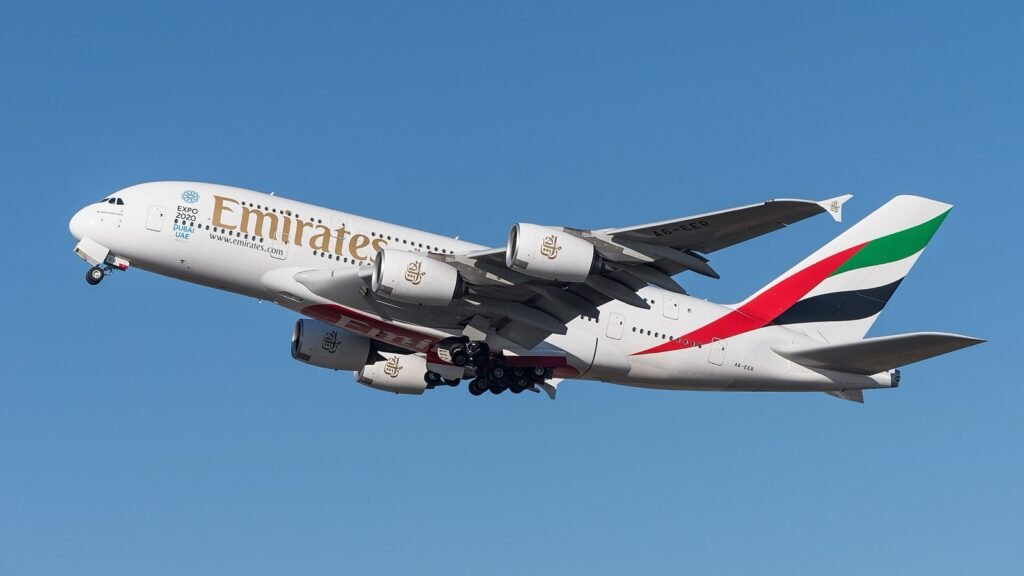
An Airbus A380, the best-known Code F aircraft, at Munich in 2015. In September 2026 the Government asked ANA to demonstrate that the new airport's runways and taxiways are fully compatible with Code F aircraft. Photo not taken in Portugal.
“Emirates Airbus A380-861 A6-EER MUC 2015 04”, © Julian Herzog, CC BY 4.0, via Wikimedia Commons. Resized to 1,600 px wide.

Illustration — not to scale, not the airport design
An aircraft on final approach to a lit runway.
Illustration: Luís de Camões Airport Observatory (original work).
What the documents say
- Status: Under review Fact
The Government identified airside matters needing further demonstration: the configuration of the runways and taxiway network and its full compatibility with Code F aircraft, capacity and operational flexibility.
Source: Portuguese Government — Ministry of Infrastructure and Housing Details and history: Government asks ANA to demonstrate Code F compatibility
- Status: Officially proposed Proposal
Preparatory actions listed in July 2026 include restructuring airspace to fit the new airport alongside other civil and military traffic, and planning water, fuel, electricity and telecommunications supply.
Source: ANA – Aeroportos de Portugal (VINCI Airports) Details and history: Airspace restructuring and utility networks are being planned
- Status: Officially proposed Proposal
The July 2026 design provides for two runways in the initial phase.
Source: ANA – Aeroportos de Portugal (VINCI Airports) Source: VINCI Airports Source: Jornal de Negócios Details and history: Two runways in the initial phase
- Status: Under review Fact
The Government confirmed that some of the minimum specifications in the concession contract are partly out of date and need updating. Of nine changes proposed by ANA, most were considered pertinent; two remained subject to further technical analysis.
Source: Portuguese Government (XXV Constitutional Government) Details and history: Minimum specifications of the concession need updating
- Status: Under review Proposal
Among the specification changes discussed in 2025 were openness to reducing the maximum runway length, increasing the distance between runways to allow triple independent operations, and more contact stands to allow walk-boarding.
Source: Portuguese Government (XXV Constitutional Government) Details and history: Proposed changes: shorter maximum runway length, wider runway separation
- Status: Target / forecast Forecast
The 2024 decision recommended a base model of two runways handling 90–95 movements an hour, with the possibility of expanding to four runways for passenger traffic that could exceed 100 million a year by 2050.
Source: Portuguese Government (XXIV Constitutional Government) Details and history: 2024 base model: two runways, expandable to four
Open questions
What are the runways’ length, spacing, orientation and Code F design?
Open
Why it matters
Runway geometry drives noise contours, flight paths, capacity and land take.
What is known so far
Two runways are proposed. The Government asked ANA in September 2026 to demonstrate Code F compatibility. Dimensions have not been published in the sources reviewed.
Source: Portuguese Government — Ministry of Infrastructure and Housing Source: Portuguese Government (XXV Constitutional Government)
How will airspace be restructured around civil and military traffic?
Open
Why it matters
Flight paths decide which communities are overflown.
What is known so far
Airspace restructuring is listed among preparatory actions. No airspace design has been published in the sources reviewed.
Questions answered
What is Code F and why is it in the news?
Code F is the largest aircraft category in the international aerodrome reference code, used for aircraft with the widest wingspans. Runways, taxiways and stands must be designed for it. In September 2026 the Government asked ANA to demonstrate full Code F compatibility.
Source: Portuguese Government — Ministry of Infrastructure and Housing Permalink: What is Code F and why is it in the news?
How long will the runways be, and in which direction?
Not established in the public record
Unknown. Runway dimensions, spacing and orientation have not been published in the sources reviewed. A 2025 discussion of the concession’s minimum specifications considered allowing a shorter maximum runway length.
Source: Portuguese Government (XXV Constitutional Government) Permalink: How long will the runways be, and in which direction?
Where will planes fly, and who will hear them?
Not established in the public record
Unknown at this stage. Flight paths depend on runway orientation and on the airspace restructuring that is being planned. Noise contours will be in the environmental study, whose consultation had not opened at the baseline date.
Source: Agência Portuguesa do Ambiente (SIAIA) Source: ANA – Aeroportos de Portugal (VINCI Airports) Permalink: Where will planes fly, and who will hear them?
Sources
Government responds to ANA’s technical report on the new Lisbon airport
Original: Government responds to ANA’s technical report on the new Lisbon airport Link checked
ANA delivers the technical report for the new Lisbon airport
Original: ANA delivers the technical report for the new Lisbon airport Link checked
Government responds to ANA’s consultation report and publishes it
Original: Government responds to ANA’s consultation report and publishes it Link checked
Related explainers
Investigation
The 28 September letter: what the Government sent back to ANA
Demand, Code F, a single terminal and the calendar. The Government’s response to the technical report reopens the design’s biggest questions.
Explainer
Code F: why the largest aircraft shape a runway debate
The Government wants proof the airport works for the widest-winged aircraft. What Code F is, and why it matters for runways, taxiways and stands.